How to Remove Hard Water Stains from Glass Shower Doors in Edmonton
Last updated November 2026 · Best Glass Parts Guide Team, Edmonton
Quick answer: To remove hard water stains from glass shower doors, wash off soap scum first, then soak the spots with white vinegar for 10 to 15 minutes and scrub with a non-scratch pad. For heavy buildup, use an acidic scale remover as its label directs, then rinse, squeegee and dry. Haze that survives several rounds is likely etching.
Hard water stains are the white spots and cloudy film that calcium and magnesium leave when water dries on glass. Edmonton's water is hard, so they return quickly. The right acid dissolves most buildup, but the wrong tool can scratch tempered glass for good.
Key takeaways
- Hard water spots are mineral deposits that a mild acid, such as white vinegar or a descaler, dissolves.
- Wash off soap scum first, give the acid time to work, then rinse, squeegee and dry.
- Glass makers advise against razor blades and metal scrapers on tempered shower glass.
- Keep acids off marble and polished stone, and never mix any cleaner with bleach.
- Haze that survives several careful cleanings is usually etching, which needs polishing or new glass.
- Edmonton's water averaged 174 mg/L hardness in August 2026, so squeegee after every shower.
Is it hard water stains, soap scum or etched glass?
Identify the problem first, because each has a different fix. Hard water leaves spots as it dries, and soap reacts with its calcium to form soap scum (U.S. Geological Survey). Etched glass stays hazy even after a thorough cleaning (CLR).
| What you see | Likely cause | Quick test | What to do |
|---|---|---|---|
| White spots or rings, worst low on the door | Hard water mineral deposits | A vinegar-soaked paper towel softens them in 15 minutes | Steps 3 to 5 below |
| Grey, greasy film | Soap scum mixed with minerals | Dish soap and warm water lift some of it | Wash first (Step 2) |
| Chalky crust on edges, hinges and the sweep | Limescale built up over months | Feels rough and softens slowly with acid | Repeat treatments; replace a crusted sweep |
| Even, milky haze that never fully clears | Etching (glass corrosion) | Still there after several acid cleanings | Professional polishing or new glass |
| Fine lines that show in bright sunlight | Scratches from blades or abrasives | No cleaner changes them | Stop scraping; scratches are permanent |
Don't let it build up: deposits that hold moisture against glass can cause staining and etching (Pilkington).
How hard is Edmonton's water?
Hard. EPCOR's August 2026 water quality summary reports total hardness at its Edmonton treatment plants averaging 174.0 mg/L as calcium carbonate, ranging from 166 to 181 mg/L (EPCOR). February 2026 averaged 187.5 mg/L (EPCOR). The U.S. Geological Survey classes 121 to 180 mg/L as hard and anything above 180 mg/L as very hard (USGS).
| EPCOR summary | Average total hardness | Range | USGS class |
|---|---|---|---|
| February 2026 | 187.5 mg/L (about 11 gpg) | 176–204 mg/L | Very hard |
| August 2026 | 174.0 mg/L (about 10 gpg) | 166–181 mg/L | Hard |
| January to August 2026 | 176.3 mg/L (about 10 gpg) | 146–264 mg/L | Hard |
Softeners are sized in grains per gallon (gpg). Health Canada gives 1 gpg as 17.1 mg/L, so Edmonton's water is roughly 10 to 11 gpg. Health Canada sets no health-based limit for hardness, and notes that heating water makes the carbonate part drop out as scale, as in a kettle (Health Canada).
What is the best cleaner for hard water stains on shower glass?
Start mild and step up only if you need to. Pilkington lists one part clear vinegar to one to ten parts water for routine glass washing (Pilkington), and for hard water spots, guides suggest 10 to 15 minutes of contact (E-Cloth).
| Method | Best for | How to use it | Cautions |
|---|---|---|---|
| White vinegar | Light to moderate spots and film | Spray or soak, keep wet 10–15 minutes, scrub, rinse | Keep off marble and polished stone; never mix with bleach |
| Baking soda paste | Scrubbing softened residue | Use on a damp non-scratch sponge after the vinegar | Mildly gritty; test a corner; don't mix it with vinegar |
| Commercial descaler | Heavier scale | Follow the label; CLR's Brilliant Bath directions say 2 to 3 minutes and no longer | Test a hidden spot; keep off vinyl sweeps, stone and coloured grout |
| Acidic scale-remover paste | Stubborn buildup vinegar won't shift | Rub on with a damp microfibre cloth or non-scratch sponge, rinse well | Contains a fine polishing abrasive; for problem areas, not daily use |
| Melamine foam sponge | Small stubborn spots | Wet, wring out, use light pressure | Mildly abrasive (Hellamaid); skip it on coated glass |
| Razor blade or steel wool | Not recommended | Avoid on shower glass | Can scratch tempered and coated glass |
Pilkington says razor blades and metal scrapers should not be used on fully tempered glass because they can leave fine scratches (Pilkington), and the GANA bulletin says never to use blades on coated glass (GANA). Most shower doors are tempered (CLR).

What you need to remove hard water stains from glass shower doors
- White vinegar, a spray bottle and paper towels
- Dish soap and warm water
- Non-scratch sponges and microfibre cloths
- A squeegee and rubber gloves
- Baking soda (optional)
- For heavy buildup, a scale remover such as our Glass Water Scale Remover
- A glass cleaner and, if you like, a water-repellent coating
Step 1: Check the glass and protect nearby surfaces
- Check whether your glass has a factory protective coating; if so, follow the coating maker's care instructions, which usually call for a mild, non-abrasive cleaner (CLR).
- Open a window or run the exhaust fan, and wear rubber gloves.
- Keep acids off marble and polished stone. Vinegar and limescale removers can damage a polished stone finish (FILA).
- Keep cleaners off the sweep and seals, or slide the sweep off; clean them with mild soap and water (CLR).
- Test any product on a small corner first, as the GANA bulletin recommends (GANA).
Step 2: Rinse and wash off soap scum
Rinse with warm water, then wash with a few drops of dish soap in warm water and a non-scratch sponge. Pilkington lists dishwashing liquid in low concentrations as a suitable glass-cleaning solution (Pilkington). Removing the greasy film first lets the acid reach the mineral spots. Rinse well.
Step 3: Soak the spots with vinegar
Spray undiluted white vinegar on the spots, or a half-and-half mix with warm water for light marks. On vertical glass, press vinegar-soaked paper towels onto the worst areas. Leave it 10 to 15 minutes, re-spraying anything that dries, and keep it off stone, hinges and handles.
Step 4: Scrub, rinse and check
Scrub in small circles with a damp non-scratch sponge, working from the top down (CLR). Rinse and check the glass at an angle against the light; if spots remain, repeat Step 3. A baking soda paste can lift softened residue, but use it after the vinegar, not mixed with it, since they neutralize each other.
Step 5: Use a scale remover for heavy buildup
For buildup that vinegar won't move, use a stronger acidic product and follow its label exactly. With our Glass Water Scale Remover (CL-SR-101), a paste of mild organic acids and fine polishing abrasives (pH 3.0 to 5.0), rub a small amount on with a damp microfibre cloth or non-scratch sponge. For heavier deposits, its directions allow 1 to 3 minutes of contact without letting it dry. Rinse thoroughly and repeat if needed.
For heavy buildup, repeat applications work better than leaving a cleaner on longer than its label says (CLR).
Step 6: Rinse, squeegee and dry
Rinse all cleaner off the glass, hardware and curb. Squeegee from top to bottom and dry the edges with a microfibre cloth; the GANA bulletin calls for a squeegee to remove all cleaning solution (GANA). Finish with Glass Cleaner GC 800, a streak-free glass and mirror spray.
Step 7: Protect the glass and check the hardware
A water-repellent coating helps water bead off before it dries into spots. Our Glass Coating Spray goes on clean, dry, oil-free glass and is buffed with a clean towel when almost dry. Spray-on sealants only help for a limited time, so reapply (Guardian Glass).
Then wipe hinges and handles with mild soap and water (see our guide to cleaning shower door hinges and hardware), and replace a sweep that stays white or stiff using our shower door sweep replacement guide.

When to replace sweeps, hardware or glass
When cleaning isn't enough, match the problem to the part. Choose size, colour or finish on each product page.
| Your situation | What to look for | Options |
|---|---|---|
| Lightly spotted glass you clean often | A streak-free glass cleaner and a squeegee | Glass Cleaner GC 800 |
| Heavy limescale or soap scum film | An acidic scale-remover paste | Glass Water Scale Remover |
| Clean glass you want to keep that way | A water-repellent coating, reapplied as directed | Glass Coating Spray |
| Crusted or stiff bottom sweep on a swing door | A replacement sweep for your glass thickness | 6 mm (1/4") long flap, 8 mm (5/16") swing door sweep, 10 mm (3/8") swing door sweep, 8 mm D-profile, 10 mm D-profile |
| Crusted seal under a sliding door | A slider seal for your glass thickness | 8 mm slider seal, 10 mm slider seal |
| Side or magnetic seals white with scale | H-profile or magnetic seal for the angle | 10 mm small H, 10 mm large H, 6 mm magnetic 180°, 10 mm magnetic 90° |
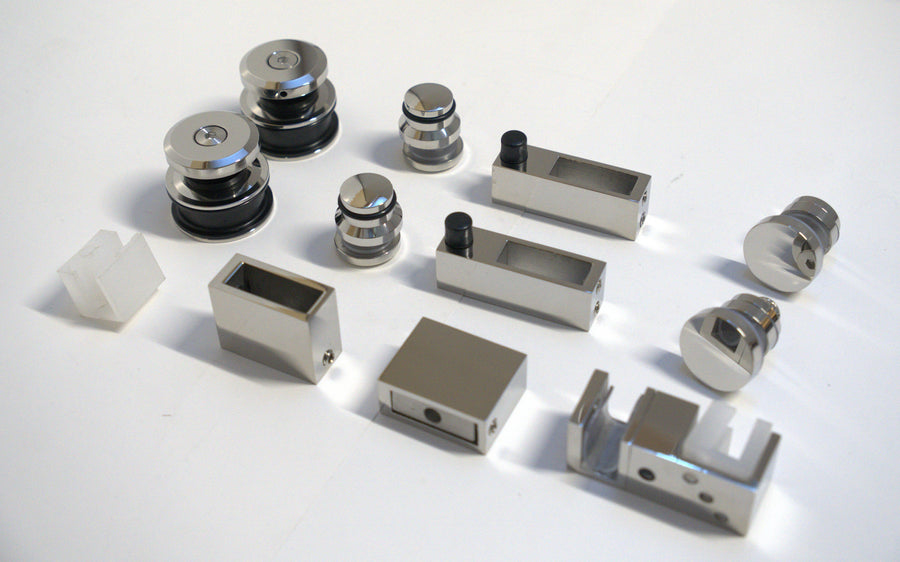
| Hinges or handles with a pitted or worn finish | Matching hardware in chrome, black, brushed nickel or gold | GEN short plate hinge, VEN full plate heavy-duty hinge, round pull handle, square pull handle, single knob, square towel bar |
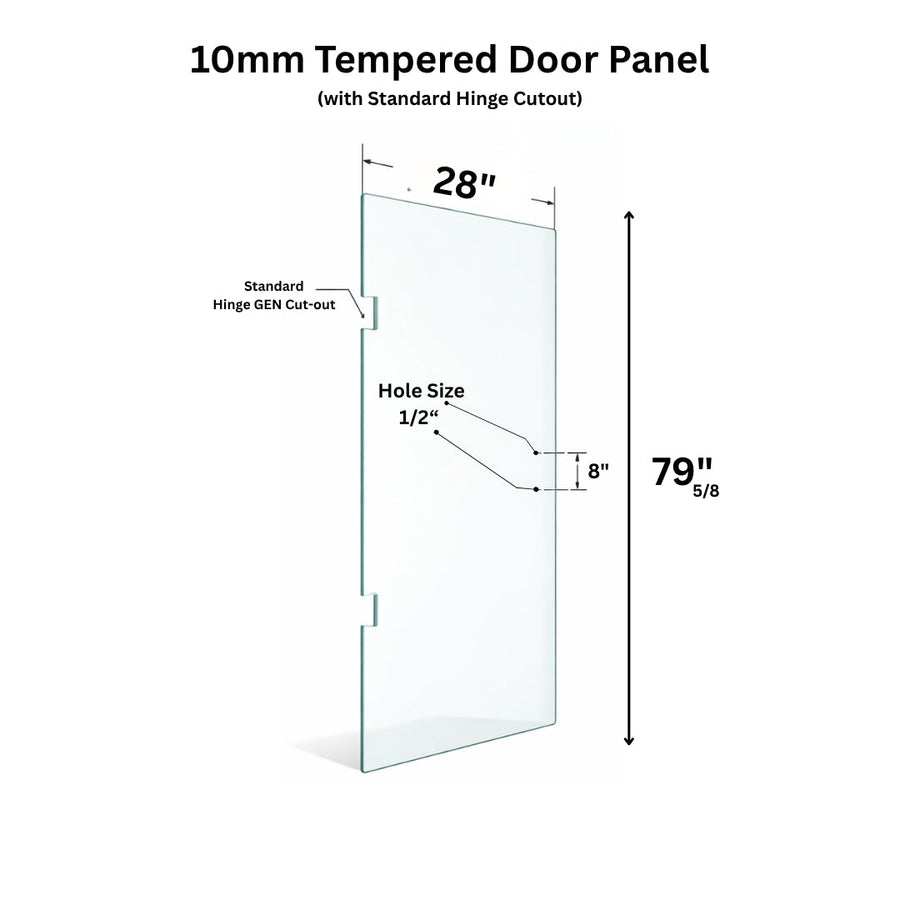
| Glass etched beyond cleaning | A tempered panel matching thickness, size and cutouts | 10 mm swing door glass with cutout, 10 mm fixed panel, 6 mm fixed panel, 8 mm sliding door glass, 6 mm sliding door glass |
Browse every profile in our shower door sweeps and bottom seals collection.

Can etched shower glass be fixed?
Not by cleaning. CLR says etching can't be cleaned away and usually needs a glass professional to repair or replace the glass (CLR). Guardian Glass explains that limescale can become embedded in standard shower glass and permanently discolour it (Guardian Glass). Your options:
- Live with light etching. Regular cleaning keeps it from getting worse (CLR).
- Professional polishing, usually by machine with a compound such as cerium oxide (Hellamaid).
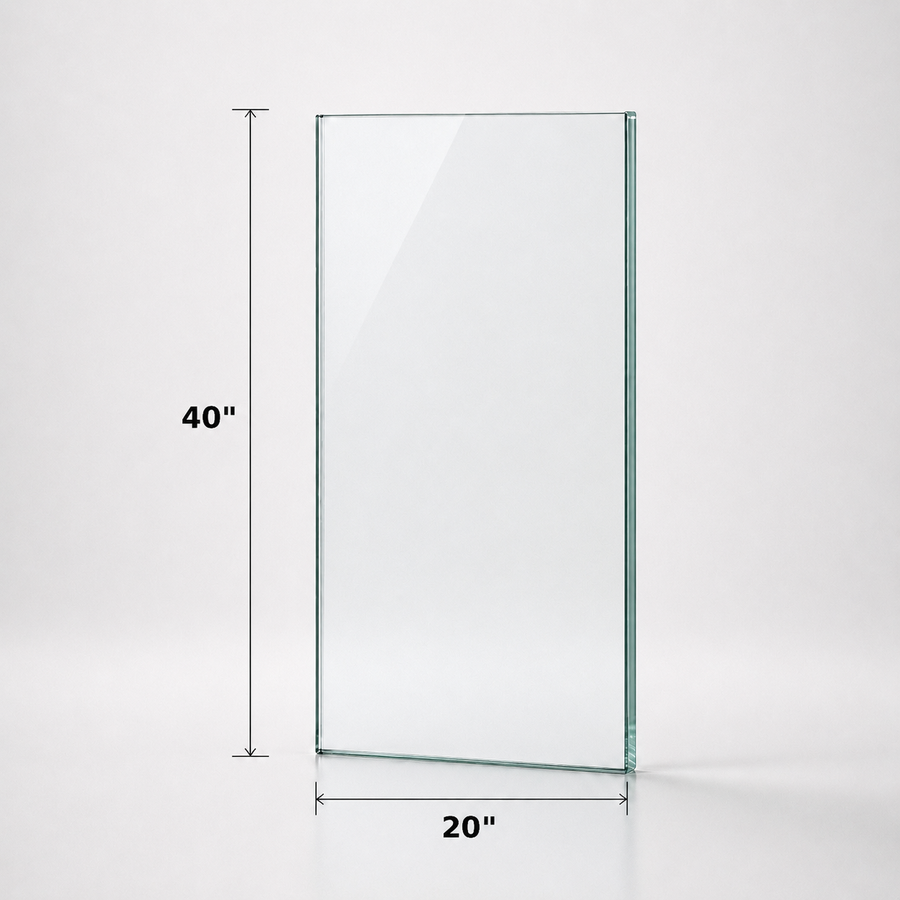
- Replace the panel. Note the thickness, exact size and hinge cutouts or holes; our guide to 6 mm (1/4"), 8 mm (5/16") and 10 mm (3/8") shower glass explains thicknesses. If you're unsure, have a qualified installer measure.

Common mistakes that make hard water stains worse
- Scraping with a razor blade or steel wool. Both risk fine scratches, and GANA says to avoid metal contact with the glass (Pilkington, GANA).
- Mixing cleaners. Bleach reacts with acids, including vinegar, and with ammonia to create toxic gases. The Government of Canada advises never mixing any cleaning product with household bleach (Government of Canada).
- Letting acid sit on stone, coloured grout or vinyl seals. Rinse any splashes right away.
- Letting cleaner dry on the glass, or skipping the rinse and squeegee.
- Scrubbing etched glass harder. More scrubbing only risks scratches.
How to prevent hard water stains on shower glass
- Squeegee after every shower and wipe the bottom edge dry.
- Ventilate with the fan or an open door so the enclosure dries.
- Clean weekly before film builds into scale.
- Reapply a water-repellent coating as directed.
- Consider a water softener. Alberta Agriculture recommends softening when hardness exceeds 100 mg/L (6 gpg) (Alberta Agriculture), and Edmonton's water is well above that.
- Ask about factory-coated glass when you replace panels (Guardian Glass).
Frequently asked questions
Does vinegar remove hard water stains from glass shower doors?
Yes, for mineral deposits. Spray or soak the spots with white vinegar, keep them wet for 10 to 15 minutes, then scrub with a non-scratch sponge and rinse. Heavy buildup may need a stronger scale remover.
Can you use a razor blade on a glass shower door?
It isn't recommended. Pilkington says razor blades and metal scrapers should not be used on fully tempered glass because they can leave fine scratches, and most shower doors are tempered.
Is a Magic Eraser safe on glass shower doors?
Melamine sponges are mildly abrasive. Test a small corner with light pressure first, and don't use them on glass with a protective coating.
Are hard water stains on glass permanent?
Mineral deposits are not; an acid cleaner removes them. Haze that stays after several careful cleanings is probably etching, which can't be cleaned away and needs polishing or new glass.
How hard is the water in Edmonton?
EPCOR's August 2026 summary reports an average total hardness of 174 mg/L as calcium carbonate, about 10 grains per gallon. That is hard on the USGS scale, and the February 2026 average of 187.5 mg/L was in the very hard range.
Will a water softener stop hard water stains on shower doors?
A softener reduces the calcium and magnesium that leave spots. Alberta Agriculture recommends softening above 100 mg/L, and Edmonton's water is well above that, but drying the glass still helps.
Can you mix vinegar and bleach to clean a shower?
No. Bleach reacts with acids, including vinegar, and with ammonia to create toxic gases, and the Government of Canada advises never mixing any cleaning product with household bleach.
How do I keep hard water spots off my shower glass?
Squeegee the glass after every shower, run the fan, and wipe the bottom edge dry. A weekly clean and a water-repellent coating also help.
Need help with hard water damage?
If your sweep, seals or glass are past saving, send us a photo and your glass thickness. Browse our frameless shower door hardware, shower door sweeps and bottom seals and tempered shower door glass, or read our shower door sweep replacement guide. Best Glass Parts ships across Canada, offers pickup in Edmonton, and contractors and glaziers can ask about trade pricing.
Sources
- EPCOR: Edmonton water quality monthly summary, August 2026
- EPCOR: Edmonton water quality monthly summary, February 2026
- USGS: Hardness of water
- Health Canada: Guidelines for Canadian drinking water quality, operational parameters (2025)
- Alberta Agriculture: Water softening
- Pilkington: Technical bulletin ATS-144, manual washing of clear and tinted glass (2025)
- GANA/IWCA: Proper procedures for cleaning architectural glass
- CLR: How to clean glass shower doors
- Government of Canada: Never mix bleach with other cleaning products
- FILA: Acid etching on marble and polished stone
- Guardian Glass: ShowerGuard
- E-Cloth: Removing hard water spots from a glass shower door
- Hellamaid: Removing hard water stains from glass shower doors