Shower Glass Thickness: 6mm vs 8mm vs 10mm – Which Do You Need?
Last updated October 2026 · Best Glass Parts Guide Team, Edmonton
Quick answer: The right shower glass thickness depends on how the glass is supported. Frameless swing doors and fixed panels normally use 10mm (3/8") tempered glass, with 12mm (1/2") for very large or heavy panels. Framed, semi-frameless, tub and many sliding doors use 6mm (1/4") or 8mm (5/16"). Always match the glass to your hardware’s rated thickness range.
Glass thickness decides how much a door weighs, how stiff it feels, which hinges and seals fit, and what it costs. Advice online often conflicts because markets differ: UK retailers tend to present 8mm as the popular choice for doors (Sanctuary Bathrooms), while North American glass companies treat 3/8" (10mm) as the frameless standard (Dulles Glass, Glass Doctor). This guide covers weights, Alberta’s code rule and the hardware made for each thickness.
Key takeaways
- Safety glazing, not thickness, is what makes shower glass safe. Alberta’s building code calls for Class A safety glazing in shower and bathtub enclosures.
- 10mm (3/8") is the usual thickness for frameless doors and fixed panels. 12mm (1/2") suits very large or lightly supported panels.
- 6mm (1/4") and 8mm (5/16") suit framed, semi-frameless, tub and sliding systems, and 8mm also suits smaller hinged doors on hinges rated for it.
- A 28" x 79-5/8" door weighs about 45 lb at 6mm, 63 lb at 8mm, 76 lb at 10mm and 99 lb at 12mm, before hardware.
- Hinges, clamps, handles, sweeps and U-channel are each made for a thickness range. Check every part before you order.
- Tempered glass cannot be cut or drilled afterwards, so sizes, holes and notches are set before it is tempered.
Shower glass thickness compared: 6mm vs 8mm vs 10mm vs 12mm
Weights are from Vitro Architectural Glass’s trade thickness chart (Vitro TD-120). Typical uses reflect what glass suppliers and hardware makers publish.
| Thickness | Weight | Typical use | What to expect |
|---|---|---|---|
| 6mm (1/4") | 14.2 kg/m² (2.9 lb/ft²) | Framed doors, tub screens, sliding kits, narrow panels held in a frame or channel | Lightest and lowest cost. Flexes more on wide panels. |
| 8mm (5/16") | 19.9 kg/m² (4.1 lb/ft²) | Semi-frameless and sliding doors, neo-angle enclosures, tub screens | Stiffer than 6mm. Needs hardware rated from 8mm. |
| 10mm (3/8") | 24.1 kg/m² (4.9 lb/ft²) | Most frameless swing doors, fixed panels and walk-in screens | The usual frameless choice in North America. |
| 12mm (1/2") | 31.3 kg/m² (6.4 lb/ft²) | Very wide or tall panels, partitions, panels with minimal support | About 30% heavier than 10mm. Needs hardware rated for the extra weight. |
Thicker glass is stiffer. A shower enclosure maker quoted by Sanctuary Bathrooms notes that a 900mm piece of 6mm glass flexes more than the same piece in 10mm (Sanctuary Bathrooms). The trade-off is extra weight and cost, and heavier doors need walls that can carry them (Glass Doctor).
Shower glass types and terms explained
- Nominal vs actual thickness: glass is sold by trade size. Vitro lists 3/8" glass as 10.0mm with an actual range of 0.355–0.406" (about 9.0–10.3mm), so "10mm" and "3/8 inch" are the same product (Vitro TD-120).
- Fully tempered glass: heat-treated glass with roughly four times the breakage strength of annealed glass of the same thickness. It breaks into small particles, which reduces the risk of serious injury (National Glass Association).
- Laminated glass: layers of glass bonded with an interlayer so broken pieces stay in place. It is another type of safety glazing.
- Annealed (float) glass: ordinary glass that has not been heat-treated. CAN/CGSB-12.1 does not treat it as safety glazing (National Glass Association).
- Wired glass: no longer accepted for shower and bathtub enclosures in Alberta since the 2019 code edition (Safety Codes Council).
- Class A and Class B: impact ratings under CAN/CGSB-12.1-2017. Class A is tested with a 1,219mm (48") drop and 542 J (400 ft-lb) of impact energy, Class B with a 457mm (18") drop and 203 J (150 ft-lb) (Construction Canada).
Is 8mm glass thick enough for a shower door?
Yes, in the right system. 8mm (5/16") works for sliding doors, semi-frameless and neo-angle enclosures, tub screens, and smaller hinged doors on hinges rated for 8mm glass. Canadian maker Fleurco, for example, builds its Apollo sliding doors with 6mm or 8mm tempered glass (Fleurco).
For a fully frameless door or fixed panel with no frame, header or channel to stiffen it, North American glass companies generally start at 10mm (3/8"). Dulles Glass, for instance, advises against 1/4" glass on fully frameless fixed panels and treats 3/8" as the minimum (Dulles Glass).

3/8 vs 1/2 inch frameless shower glass: is 12mm worth it?
For most frameless showers, 10mm (3/8") is enough. Step up to 12mm (1/2") when a panel is very wide or tall, has little support at the top, or when you want a heavier look and feel (Dulles Glass). Expect about 30% more weight: Vitro lists 1/2" glass at 6.4 lb/ft² against 4.9 lb/ft² for 3/8". That weight needs heavier-rated hinges, clamps and wall blocking, so budget for the hardware too.
How heavy is a glass shower door?
Multiply the glass area by its weight per square metre or square foot. These figures use Vitro’s nominal weights and cover the glass alone, before handles, holes and notches.
| Door glass size | 6mm | 8mm | 10mm | 12mm |
|---|---|---|---|---|
| 24" x 72" (610 x 1,829mm) | 35 lb (16 kg) | 49 lb (22 kg) | 59 lb (27 kg) | 77 lb (35 kg) |
| 28" x 79-5/8" (711 x 2,022mm) | 45 lb (20 kg) | 63 lb (29 kg) | 76 lb (35 kg) | 99 lb (45 kg) |
| 32" x 79-3/4" (813 x 2,026mm) | 52 lb (23 kg) | 72 lb (33 kg) | 87 lb (40 kg) | 114 lb (52 kg) |
Compare the result with the hinge rating. Our GEN Standard hinges are listed for doors up to 80 lb (36 kg) and 28" wide on two hinges, or 120 lb (54 kg) and 32" wide on three. A 28" x 79-5/8" door in 10mm is close to the two-hinge limit, so a third hinge or a heavy-duty hinge gives more margin.
What Alberta’s building code says about shower glass
Alberta’s code rule for shower glass is about the type of glass, not a set thickness. For houses and small buildings, Sentence 9.6.1.4.(6) of the National Building Code – 2023 Alberta Edition says glazing used for a shower or bathtub enclosure must conform to Class A of CAN/CGSB-12.1, "Safety Glazing" (NBC(AE) 2023 Part 9 code changes). The 2023 Alberta Edition is based on the National Building Code of Canada 2020 (National Research Council Canada).
Safety glazing made to the 2017 edition of CAN/CGSB-12.1 carries a permanent mark that shows the standard, a size designation and its class, A or B (National Glass Association). Look for that mark on the glass. Requirements change and municipalities enforce them, so confirm with your local building department, such as the City of Edmonton or City of Calgary, or with a qualified installer before you buy.
What you need
- Tape measure
- Digital or dial caliper for measuring existing glass
- Glass cleaner and a lint-free cloth to clear scale off the edge before you measure
- The specification for your hinges or kit: glass range, maximum weight and maximum width
- A calculator for the weight check
Step 1: Decide how the glass will be supported
Support sets your starting thickness. Glass held by a frame or track can be thinner than glass that hangs from two hinges with nothing else around it.
- Frameless swing door or fixed panel: start at 10mm (3/8"). Consider 12mm (1/2") for very wide, tall or lightly supported panels.
- Sliding door: use the thickness the roller system is made for, commonly 6mm, 8mm or 10mm.
- Framed, semi-frameless or tub door: 6mm (1/4") or 8mm (5/16"), as specified by the frame or kit.
Step 2: Measure the glass you already have
For replacement parts, measure the glass itself, not the old hinge or seal. Clean the edge, then close the caliper jaws on bare glass away from any gasket. A reading slightly off the trade size is normal (Vitro TD-120):
| Trade size | Actual thickness range |
|---|---|
| 6mm (1/4") | 5.6–6.0mm |
| 8mm (5/16") | 7.4–8.4mm |
| 10mm (3/8") | 9.0–10.3mm |
| 12mm (1/2") | 11.9–13.5mm |
Step 3: Check the weight against the hinge rating
Use the weight table above, or multiply the door’s area in square metres by 14.2 (6mm), 19.9 (8mm), 24.1 (10mm) or 31.3 (12mm) kg. Then check the hinge’s listed maximum weight and width for two and three hinges. If the door is near the limit, add a hinge or choose a heavy-duty hinge.
Step 4: Match every part to the thickness
Every part that grips the glass is made for a thickness range. Use this table to find parts listed for yours.
| Your situation | What to look for | Options |
|---|---|---|
| Frameless swing door, 10mm or 12mm, up to 36" wide | Hinges listed for 10–12mm and your door weight | VEN heavy-duty full plate, VEN heavy-duty S plate, VEN 180° glass-to-glass (listed to 110 lb/50 kg on two hinges, 140 lb/63 kg on three) |
| Frameless swing door, 8mm, or a narrower 10mm door | Hinges listed from 8mm | GEN standard short plate, GEN standard full plate (listed for 8–12mm) |
| Pivot door, 8–10mm | Top-and-bottom pivot listed for your glass | heavy-duty pivot hinge (listed for 8–10mm, to 100 lb/45 kg and 31" wide) |
| Replacement door or fixed panel | Same thickness and hardware cutouts as the old glass | 10mm swing door glass with cutout, 10mm fixed panel, 10mm fixed panel (80" high), 6mm pivot door glass, 6mm fixed panel, 8mm neo-angle panel |
| Sliding door | A roller system made for your thickness | 6mm sliding kit, 8mm Skyline full set, 10mm Skyline full set, 10mm Clear Flow kit, 8mm sliding glass, 10mm roller sliding glass |
| Tub screen, framed door or 6mm pivot door | A track, frame or kit sized to the glass | 6mm tub door kit, 8mm tub door kit, 8mm Nova framed kit, 6mm pivot door hardware kit |
| Door handle | A handle listed for your glass and hole size | square pull handle (6–12mm, 1/2" holes), H round pull handle (8–12mm in 6"–12" sizes) |
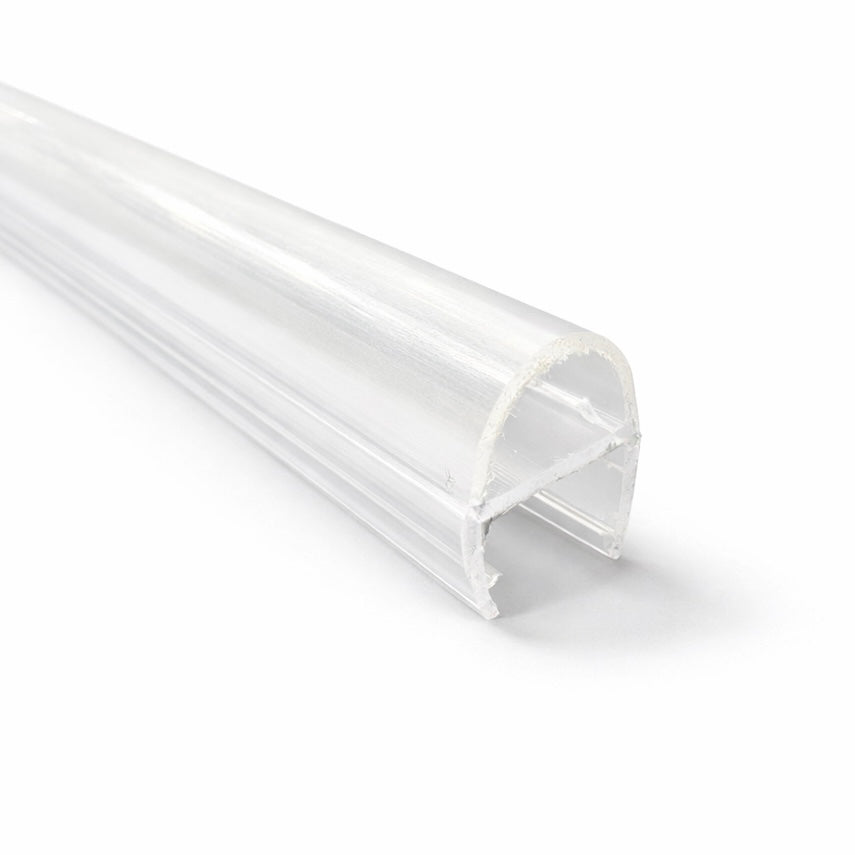
| Channel and seals | Profiles made for the exact thickness | 3/4" U-channel (6, 8, 10 or 12mm), 1" U-channel for 10mm, 6mm sweep, 8mm sweep, 10mm sweep, 12mm partition seal |

Step 5: Confirm safety glazing and order to exact size
Tempered glass cannot be safely cut after it has been tempered (Vitro TD-138), and cutting, drilling and edging have to be done before heat treatment (National Glass Association). Confirm the opening size, hinge cutouts and handle holes against your hardware’s fabrication details before you order, then check the safety-glazing mark when the glass arrives.

Common mistakes when choosing shower glass thickness
- Buying hardware for the wrong thickness. A hinge listed for 10–12mm glass is not made to hold 8mm glass. Check the listed range on every part.
- Ignoring weight and width limits. A wide 10mm or 12mm door can exceed a two-hinge rating even when the thickness fits.
- Assuming thicker means code-compliant. Thick annealed glass is still not safety glazing. Tempering and the safety-glazing mark matter.
- Letting glass touch metal or tile. Edge damage significantly reduces glass strength (National Glass Association). Keep glass off metal with gaskets, and with setting blocks in channels.
- Mixing thicknesses without checking connectors. Panels in one enclosure can differ, but any glass-to-glass hinge, clamp or seal must suit both panels.
- Underestimating the lift. A 28" x 79-5/8" door in 10mm weighs about 76 lb. Plan for two people and a suction lifter.
Frequently asked questions
What is the standard thickness for shower glass?
North American glass companies treat 10mm (3/8") tempered glass as the standard for frameless doors and fixed panels. Framed, tub and many sliding doors use 6mm (1/4") or 8mm (5/16") glass.
Is 6mm glass OK for a shower screen?
Yes, when it is tempered and held by a frame, track or channel, as in tub screens, framed doors and many sliding kits. For a fully frameless panel or swing door, North American glass companies treat 10mm (3/8") as the minimum.
How heavy is a 10mm glass shower door?
10mm glass weighs about 24.1 kg per square metre (4.9 lb per square foot). A 28" x 79-5/8" door is about 76 lb (35 kg) before hardware.
Can I use 8mm glass with 10mm hinges?
Only if the hinge’s listed glass range includes 8mm. Our GEN Standard hinges are listed for 8–12mm glass, while our VEN Heavy Duty hinges are listed for 10–12mm, so an 8mm door needs a hinge like the GEN range.
Is 3/8 inch glass the same as 10mm?
Yes, they are the same trade size. Vitro lists 3/8" glass as 10.0mm with an actual range of about 9.0–10.3mm, so a caliper reading of 9.5mm is normal.
Does thicker shower glass make it safer?
Not on its own. Safety comes from tempering: fully tempered glass has about four times the breakage strength of annealed glass of the same thickness, and Alberta’s building code requires Class A safety glazing for shower and bathtub enclosures.
Can you cut tempered shower glass to size?
No. Tempered glass cannot be safely cut after it has been tempered, so sizing, holes and notches are done before the glass is heat-treated.
What thickness glass is used for sliding shower doors?
It depends on the roller system, but 6mm (1/4"), 8mm (5/16") and 10mm (3/8") are common. Canadian maker Fleurco uses 6mm or 8mm glass on its Apollo sliding doors, and our sliding kits come in 6mm, 8mm and 10mm versions.
Need help choosing glass and hardware?
Send us your opening size, glass thickness and a photo of your hardware, and we will help you match the parts. Browse our tempered shower door glass, fixed glass shower panels and frameless shower door hinges. Our shower door sweep replacement guide uses the same thickness sizing, our shower door hinge overview covers hinge types, and our U-channel guide covers channel installs. Best Glass Parts ships across Canada, offers pickup in Edmonton, and contractors and glaziers can ask about trade pricing.
Sources
- BILD Alberta – National Building Code – 2023 Alberta Edition, Part 9 code update information (PDF)
- National Research Council Canada – National Building Code – 2023 Alberta Edition
- Safety Codes Council (Alberta) – Part 9 code update information, August 2019 (PDF)
- Construction Canada – CGSB updates safety glazing standard to exclude wired glass
- National Glass Association – CAN/CGSB-12.1-2017 Safety Glazing update (PDF)
- Vitro Architectural Glass – TD-120 Flat glass trade thicknesses and weights (PDF)
- Vitro Architectural Glass – TD-138 Heat treated glass for architectural glazing (PDF)
- National Glass Association – FB45-14 Recommended applications for heat-treated glass (PDF)
- Dulles Glass – How thick should glass be for a fixed shower panel?
- Glass Doctor – Shower door glass thickness: a shopper’s guide
- Sanctuary Bathrooms – Shower glass thickness: should I get 6mm, 8mm or 10mm?
- Fleurco – Apollo sliding shower door specifications